The right choice depends on more than the pipe’s purchase price: soil, traffic, monsoon flow, hydraulic capacity, installation quality and future maintenance all affect the result. By the end, you will have a practical way to compare concrete with plastic, clay, steel and cast iron, specify the correct pipe class, and assess a supplier before ordering.
Key takeaways
- Choose concrete for heavy loads, deep burial, abrasion or fire exposure.
- Account for Nagpur’s black cotton soil, monsoon flow and traffic loading.
- Match diameter, load class, bedding and joint details to the design.
- Verify test records, dimensions, curing and delivery capacity before ordering.
When concrete pipes justify their higher handling cost
Concrete pipes justify higher handling costs when a project needs long service life, high external-load capacity and a locally workable installation. For a project asking “are concrete pipes worth it for infrastructure in nagpur”, choose them when burial depth, heavy traffic, abrasion or fire exposure outweigh the cost of haulage, lifting and careful placement.
Compare total installed cost, not the pipe quotation. Include excavation, shoring, dewatering, bedding, joints, haulage, crane or excavator time, unloading, traffic management, backfilling, testing, maintenance access and expected repairs. A nearby concrete source can reduce transport and damage risk, but inspect every delivery for cracks caused by bad slinging, dropping or point-supported stacking.
| Option | Main cost exposure | When it earns consideration |
|---|---|---|
| Concrete, IS 458:2003 | Heavy transport, lifting, bedding and joint work | Deep-buried stormwater, sewer, culvert and traffic-loaded routes |
| HDPE or PVC | Trench restraint, buoyancy control, joint and backfill requirements | Shallow, accessible lines where smooth hydraulics and light handling matter |
| Steel | Corrosion protection, welding and future coating repairs | Special crossings or high-strength applications |
| Vitrified clay | Fragile handling and joint labour | Gravity sewers where chemical resistance and established installation practice matter |
Check flow with the adopted design storm, catchment runoff, inlet blockage and outfall level. Use Manning’s equation with stated roughness; concrete’s rougher interior can require a larger diameter or steeper gradient than smooth-wall plastic. Also select the IS 458 class, such as NP2, NP3 or NP4, from structural calculations rather than diameter alone.
How Nagpur soil, monsoon water and traffic change the decision
Heavy-truck crossings, deep burial and monsoon channels make concrete’s load resistance valuable in Nagpur. The concrete pipe benefits in Nagpur include low ultraviolet sensitivity, non-combustibility, stable dimensions through temperature variation and strong resistance to abrasion from sediment-laden runoff.
| Condition | Why concrete helps | What can defeat the advantage |
|---|---|---|
| Heavy traffic or deep cover | Resists earth and wheel loads with less deflection | Poor haunch support can create point loading and cracking |
| Monsoon flow with sand and grit | Handles abrasion in storm-water lines, culverts and outfalls | An undersized network or blocked inlet still floods |
| Open or sun-exposed sections | Ultraviolet exposure does not degrade concrete like some polymers | Repeated impact during storage or handling can damage edges |
| Fire or high temperature exposure | Concrete is non-combustible and dimensionally stable | Thermal movement at poorly detailed joints can admit water |
| Black-cotton soil or waterlogged ground | A designed foundation can carry the pipe through seasonal changes | Swelling soil, groundwater and weak shoulders cause settlement and joint distress |
Do not treat a stronger pipe as a substitute for ground preparation. Investigate black-cotton soil, seasonal volume change and groundwater; then provide the specified granular bedding, firm haunches, compacted side-fill and controlled backfill. Keep trench width and construction-traffic access within the installation design.
Persistent low-flow sewage needs a separate check: biogenic sulphuric-acid corrosion can attack ordinary RCC at the crown. Use a lining, coating, ventilation measure or another material when the sewer chemistry demands it.
How to size, classify and install a concrete pipe correctly
1. Calculate the internal diameter from the design flow, not the catalogue label. Use the catchment area, runoff coefficient, adopted design-storm rainfall, inlet blockage allowance and outfall level; then check gradient, velocity and surcharge with Manning’s equation. Select the roughness coefficient for concrete and include inlet, outlet, manhole and joint losses.
A smooth HDPE or PVC pipe may carry the same flow at a smaller diameter.
2. Choose the class from structural calculations under IS 458:2003 with amendments. Check burial depth, trench width, groundwater, soil support, road traffic and construction loads before specifying NP2, NP3 or NP4.
Do not use an ordinary NP drainage pipe for a pumped main, rising main or pressurised irrigation line; those require pressure-rated pipe, joints, thrust restraint and surge analysis.
3. Design the installation as part of the pipe system. Specify the bedding material and thickness, firm trench formation, haunch support, layer-by-layer side-fill compaction and cover before heavy vehicles cross the route.
In black cotton soil, waterlogged ground or soft road shoulders, remove or stabilise unsuitable soil and control groundwater; a stronger pipe cannot cure voids or point loading.
4. Match joints to movement and water control. Use the specified spigot-and-socket or collar joint with its approved seal, clean the surfaces, align each pipe and prevent soil entering the joint. Check infiltration and exfiltration where groundwater or sewer contamination matters, and provide access for inspection and desilting before commissioning.
Where concrete beats plastic, clay, steel and cast iron
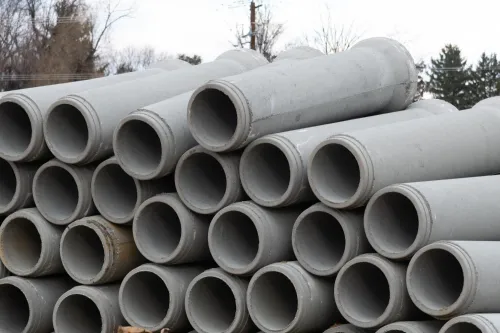
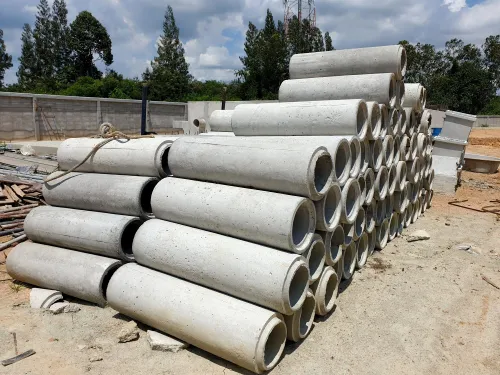
Concrete pipe applications infrastructure teams use include storm-water drains, sewer mains, road and railway culverts, irrigation channels, outfalls, manhole connections and utility crossings. Concrete earns the advantage where earth and traffic loads, fire, sunlight, abrasion or flotation risk matter more than lightweight handling.
| Material | What it offers | Where it fits |
|---|---|---|
| Concrete, RCC or Hume | Reinforced precast wall; high load capacity and stable dimensions | Deep-buried storm drains, sewers, culverts and road crossings |
| HDPE or PVC | Light, flexible and corrosion-resistant; vulnerable to deflection, uplift and heat | Shallow utilities, smaller drains and chemically aggressive flows |
| Vitrified clay | Smooth bore and strong chemical resistance; brittle joints and difficult cutting | Gravity sewers with suitable bedding and careful handling |
| Steel | High strength at low weight; corrodes without protection and transfers heat | Long spans, special crossings and situations requiring fabrication |
| Cast iron | Strong, fire-resistant and pressure-capable; heavy and costly | Pressurised utilities, buildings and exposed service lines |
RCC means reinforced cement concrete; “cement pipe” may mean a plain or generic concrete pipe, so ask for reinforcement and test records. “Spun” identifies centrifugal manufacture, not a separate performance class. “Hume” is a trade name commonly used for spun reinforced concrete pipe.
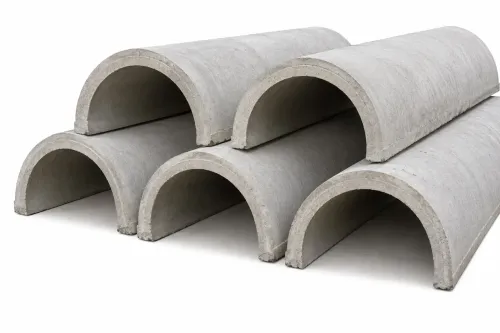
“Round” describes a closed circular section; “half-round” describes an open channel, useful for surface drainage but unsuitable where a sealed sewer or culvert is required.
For sewage with long retention or high organic loading, specify a lining or another material: biogenic sulphuric acid can attack an ordinary concrete crown. For RCC drainage and culvert work, check the specified IS 458:2003 class, such as NP2, NP3 or NP4, against the structural calculation rather than choosing by diameter alone.
What to verify before choosing a concrete pipe supplier in Nagpur
Accept a pipe lot only when its paperwork, test results and physical condition agree. Ask a concrete pipe supplier in Nagpur for these records before unloading:
- IS 458 compliance showing the applicable pipe class, concrete grade, reinforcement details, dimensional tolerances and minimum three-edge-bearing load.
- Test certificates identifying the lot, casting date, specimen, laboratory and three-edge-bearing result; arrange independent acceptance testing where the contract requires it.
- Batch records linking cement, aggregates, water, reinforcement and mould numbers to each lot.
- Curing logs covering the hot season, plus inspection evidence for cracks, honeycombing, exposed steel and permeable surfaces.
- Handling and delivery plans stating sling points, lifting equipment, truck access, unloading space, stacking limits and protection from point loads.
| Check | Accept | Reject or investigate |
|---|---|---|
| Dimensions | Diameter, length, wall thickness, socket or spigot and end squareness match the specification | Ovality, damaged joints or out-of-square ends |
| Reinforcement | Cage position and cover match approved drawings | Exposed, displaced or missing steel |
| Surface | Sound, uniform concrete without structural cracks | Long cracks, impact marks or honeycombing |
| Delivery | Each pipe carries a lot mark and arrives supported without dropping | Unmarked pipes, mixed classes or transport damage |
Vishal Cement Product is worth assessing by the same evidence, not by a quoted rate or local address. Confirm stock of the required class and delivery sequence to the work front; local supply reduces handling exposure but does not replace inspection.
Related products
 | Concrete Spun Pipe Material Concrete Usage/Application Drainage Diameter 1200 MM Length 8 feet Shape Round We have been counted amongst the most trusted names in this... View product → |
 | Concrete Pipe Pipe Type rcc pipe Diameter 600 mm Material RCC Length 2.5 meter Banking on the skills of our qualified team of professionals, we are involved in... View product → |
Frequently asked questions
When are concrete pipes worth their higher handling cost?
Choose concrete when long service life, high external-load capacity, abrasion resistance or fire performance outweighs lifting and transport costs.
How do Nagpur soil, monsoon water and traffic affect pipe selection?
Black cotton soil needs attention to swelling and shrinkage, monsoon flows require hydraulic capacity, and traffic determines the buried-load class and installation depth.
How do you size, classify and install a concrete pipe correctly?
Calculate design flow and required diameter, specify the load class, then install the pipe on approved bedding with aligned joints, controlled backfill and proper compaction.
Where does concrete outperform plastic, clay, steel and cast iron?
Concrete suits high-load drainage and infrastructure work; plastic is easier to handle, clay suits certain gravity sewers, steel suits lighter specialised structures, and cast iron suits pressurised or highly durable networks.
What should you verify before choosing a concrete pipe supplier in Nagpur?
Check dimensional consistency, reinforcement details, curing, test documentation, batch traceability, available sizes, delivery equipment and experience with your installation conditions.
Related products
 | Cement Spun Pipe Material Cement Usage/Application Drainage Diameter 150 mm Length 2.5 meter Shape Round We are a highly acknowledged organization, engaged in... View product → |
 | Cement Pipe Material Cement Shape Round Diameter 600 mm Length 2.5 meters We are a most trusted name among the topmost companies in this business, involved in... View product → |
 | RCC Hume Pipe Size 300 mm Class NP2 Pipe Type RCC Material RCC Shape Round Diameter 300 mm Thickness 30 mm Leveraging the skills of our qualified team of... View product → |
 | RCC Round Pipe Shape Round Pipe Type RCC Material RCC Thickness 30 mm Length 2.5meter Diameter 300 mm We have carved a niche amongst the most trusted names in this... View product → |
Keywords