Choosing between a precast channel and a formed open drain depends on runoff volume, slope, traffic, available land, cleaning access, and the safety of the discharge route. You will be able to select the drainage form, estimate its hydraulic need, specify installation details, and compare materials before requesting quotations.
Key takeaways
- Use half-round channels for visible, straight rainwater routes with few crossings.
- Size the channel from catchment area, rainfall intensity, slope, and safe outlet capacity.
- Install three-metre sections on a prepared bed with restrained joints and protected ends.
- Specify dimensions, concrete quality, joint treatment, access points, cleaning, and inspection duties.
Which drainage form suits your Nagpur site?
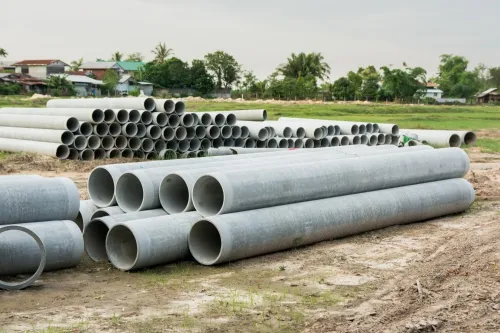
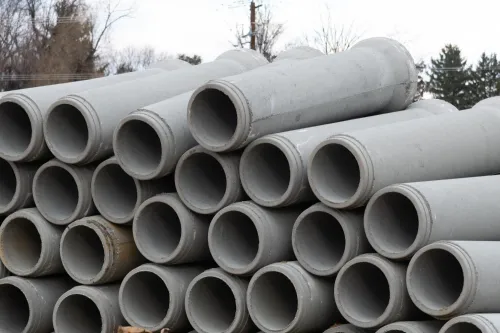
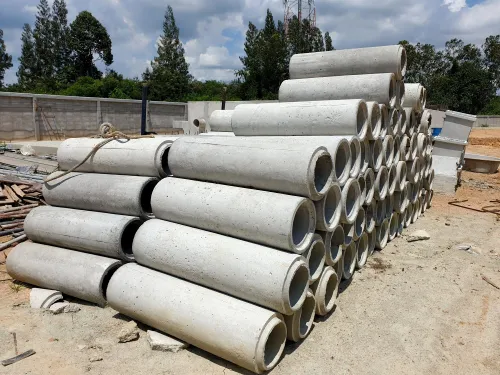
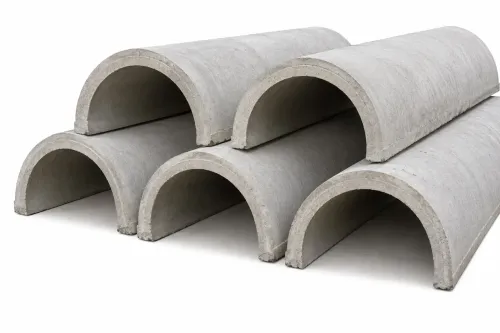
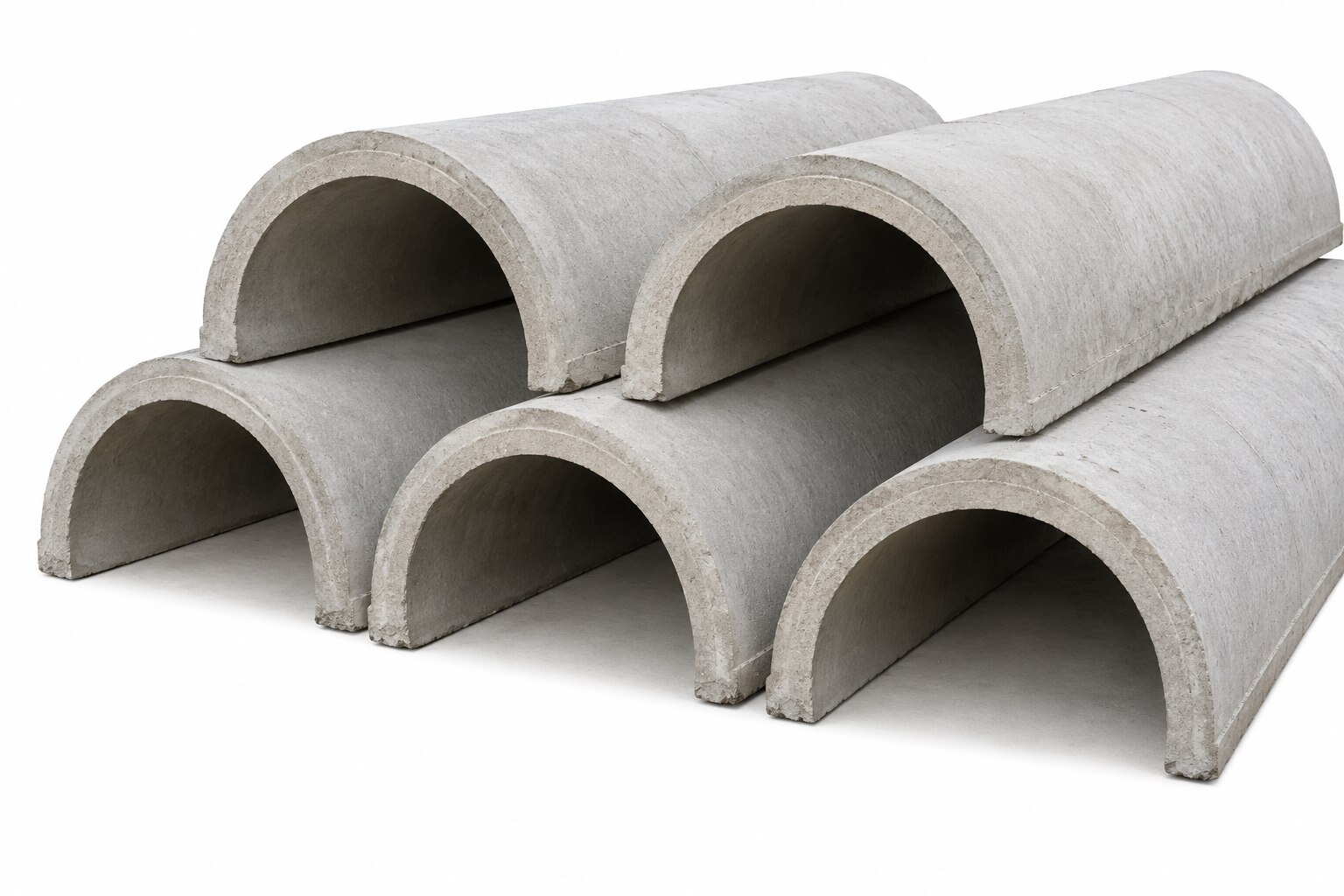
Choose an RCC half-round channel for visible roof downpipe discharge, compound edges, verges, farm access roads, construction sites, and short temporary routes when the line is reasonably straight and crossings are limited. It is an open channel, not a buried pressure pipe.
| Option | Installation and hydraulic behaviour | Access, safety and appearance |
|---|---|---|
| RCC half-round channel | Fast placement on prepared bedding; smooth semicircular flow path suits controlled, visible runoff and a defined outlet. | Easy to inspect and desilt, but leaves, plastic and construction debris remain exposed. It uses little land and looks orderly beside walls or verges, yet its open edge creates a fall and trip hazard. |
| Brick, concrete, stone or earth open drain | Better for irregular inlets, broad roadside collection, integrated kerbs, greater depth and changing levels. Cast-in-situ concrete adapts best; earth needs repeated reshaping after erosion. | Occupies more right-of-way and can look rough, but supports larger collection routes and planned walking or vehicle crossings. Build silt points and control the outlet against scour. |
For an rcc half round pipe or open drain in nagpur, choose the fully formed drain when pedestrians, vehicles or several side inlets govern the route. Add removable grates or covers at pedestrian paths, property entrances and crossings.
Never place an unprotected half-round unit under a driveway or road; specify a designed cover slab, box section or culvert with load capacity and cleaning access. The outlet still needs a defined level, apron or erosion protection so concentrated flow does not undermine the drain.
How do you size an RCC half-round channel for rainwater?
A defensible size starts with the catchment, not a catalogue diameter. Map roof, paved, roadside, and farm surfaces, then record each area and runoff surface before sizing an RCC half-round pipe for rainwater.
1. Select design rainfall intensity from an accepted local Nagpur IDF relationship or storm-frequency record. State the return period and identify the time of concentration from the hydraulically longest flow path. Design intensity and storm duration control sizing; annual rainfall total does not.
2. Estimate runoff from each mapped surface and combine the flows at each inlet. Check the channel with Manning’s equation: Q = (1/n)AR^(2/3)S^(1/2). For a semicircle flowing to its rim, A = πD²/8, wetted perimeter = πD/2, and hydraulic radius R = D/4.
3. As illustrations only, a 300 mm channel at 1% slope with assumed concrete n = 0.013 carries about 0.048 m³/s; a 450 mm channel under the same assumptions carries about 0.142 m³/s. These figures exclude freeboard, sediment, inlet losses, joints, and downstream restrictions.
4. Draw inlet spacing, silt traps, outlet levels, and an overflow route for blockage or exceedance. Check the longitudinal slope: flat channels deposit silt, while steep outlets and joints need erosion protection. Verify the receiving drain before approving the section.
How should the three-metre sections be installed and restrained?
Three-metre sections stay in place only when the ground, bedding, joints, and side restraint are designed together. Set out the invert and excavation width from the unit’s outside width, adding space for haunching and compaction; never lay an RCC half-round channel on loose soil.
- Remove soft spots, compact the subgrade, and install the specified granular bedding or concrete cradle. Extend and repair the foundation where soil bearing changes.
- Set each unit to the designed longitudinal grade. Check line, invert level, and joint alignment after every three-metre placement; a low joint becomes a silt trap.
- Treat joints with the specified cement mortar, sealant, or flexible detail. Do not substitute dry packing or leave open gaps that admit water and erode the bedding.
- Compact haunching on both sides, or provide concrete side support, so runoff, vibration, and minor impact cannot shift the sections.
- Confirm the actual model’s wall thickness. A stated range of 25–40 mm does not mean one thickness suits every span, soil condition, or load.
- Match section and reinforcement to verge exposure, pedestrian use, soil bearing, differential settlement, unsupported length, and driveway or road loading.
- Protect the outlet with a concrete apron, riprap, or another erosion-control detail. Extend protection far enough to prevent downstream scour.
- Install removable grates or load-rated covers at crossings, while retaining access for lifting, inspection, and desilting.
| Exposure | Required arrangement | Consequence if omitted |
|---|---|---|
| Compound edge | Bedded units with compacted haunching | Shifting and cracked joints |
| Pedestrian crossing | Removable grate or cover | Falls and blocked access |
| Driveway or road | Designed load-rated cover, box, or culvert | Structural failure |
| Outlet | Apron or riprap | Undermining and scour |
Which open-drain material fits the site and its failure risk?
Choose the material by its likely failure, not by metre price. Among open drain materials in Nagpur, compare hydraulic consistency, installation control, maintenance, and exposure to vehicles or pedestrians.
| Option | Strength | Failure risk and best use |
|---|---|---|
| Precast RCC half-round or U-shaped | Repeatable dimensions, smooth hydraulic surface, fast placement | Needs accurate bedding, jointing, lifting, and traffic protection; suits straight roof, verge, compound, or farm-road runs |
| Cast-in-situ reinforced concrete | Adapts to irregular alignments, kerbs, inlet boxes, and changing depths | Requires formwork, reinforcement control, and curing; poor curing produces cracks |
| Brick masonry with cement plaster | Locally repairable and suitable for modest flows | Uneven joints, plaster loss, seepage, and variable workmanship increase maintenance |
| Stone masonry | Tolerates rough roadside conditions and local repairs | Irregular surfaces and joints reduce hydraulic consistency and trap silt |
| Compacted earth | Lowest effort for broad farm or temporary channels | Erosion, vegetation, burrowing, sediment, and monsoon reshaping create the highest maintenance risk |
A fully formed drain wins for irregular catchments, integrated roadside collection, frequent crossings, high pedestrian exposure, or a continuous covered route. Precast units need less site time, but a failed joint or unprotected crossing can undermine that advantage.
Compare total installed effort: excavation, bedding, sidewalls, covers, curing, repair, cleaning, and outlet protection. Choose earth only where reshaping is acceptable; choose masonry where local repair matters more than a uniform hydraulic surface.
What should you put in the purchase and maintenance specification?
Put the design, not just “RCC half-round pipe,” into the purchase request. Ask every rcc half round pipe supplier in nagpur to quote against the same section, loading, delivery access, and installation detail.
| Specification item | Write in the request | Check before accepting |
|---|---|---|
| Internal section | Internal diameter, wall thickness, three-metre unit length, end profile, reinforcement, concrete grade or mix, and dimensional tolerances | Match the section drawing, not only the catalogue description |
| Installation | Joint treatment, design slope, compacted bedding or concrete cradle, side restraint, and outlet apron or scour protection | Confirm the detail prevents settlement, joint opening, and erosion |
| Use and evidence | Pedestrian, verge, or traffic-side loading; section drawing; curing procedure; applicable test or load data | Reject assumptions that a verge unit can pass beneath a driveway |
IS 458 specifies precast concrete pipes, but an exposed semicircular channel is not automatically covered by every requirement for a complete circular pipe. Vishal Cement Product can be compared with other local manufacturers only after these details are checked; availability does not prove hydraulic suitability.
Name the maintenance owner and frequency in the handover schedule:
- Inspect after every major storm; remove leaves and plastic immediately.
- Desilt inlets and collection points monthly during monsoon and after visible buildup.
- Check grates, joints, cracks, and outlet scour monthly and after flooding.
- Record the catchment, rainfall assumption, slope, discharge point, and overflow route so a repair does not erase the design logic.
Related product
 | RCC Half Round Pipe Unit Pipe Length 3 meter Thickness 25-40 mm Material RCC Shape Half Round We have carved a niche amongst the most dominant names in this domain,... View product → |
Frequently asked questions
When does an RCC half-round pipe suit a Nagpur rainwater route?
Choose it for visible roof downpipe discharge, compound edges, verges, farm access roads, construction sites, and short temporary routes when the alignment is reasonably straight and crossings are limited.
How do you size an RCC half-round channel for rainwater?
Calculate the contributing catchment area, use the design rainfall intensity for the site, account for surface runoff, and check that the channel slope and outlet can carry the resulting flow without overtopping.
How should three-metre RCC half-round sections be installed?
Prepare a stable, even bed, set each section to the planned line and fall, close or treat joints to limit leakage and erosion, and restrain sections against movement at bends, outlets, crossings, and exposed edges.
Which open-drain material fits a site with higher failure risk?
Compare RCC, cast-in-place concrete, masonry, lined earth, and other local options against vehicle loading, soil erosion, debris, maintenance access, alignment changes, and the consequence of a blocked or damaged drain.
What belongs in an RCC half-round drain purchase specification?
State internal dimensions, section length, concrete and reinforcement requirements, end details, tolerances, lifting points, joint treatment, inspection criteria, delivery checks, and the cleaning and maintenance arrangement.
Keywords